日本患者由来がんモデル学会 学術集会
2026
公式サイト

2026
8月19日(水)- 20日(木)- 21日(金)
会場:国立がん研究センター 新研究棟1階
〒104-0045 東京都中央区築地5-1-1
ご挨拶

本年も、日本患者由来がんモデル学会学術集会を開催できる運びとなりました。ご参加いただく皆さまに心より感謝申し上げます。日本患者由来がんモデル学会は、臨床検体を用いたがんモデルの樹立や応用に携わる研究者が、日々の研究成果や新たな発想を共有し、切磋琢磨するための場として設立されました。
現在にいたるまで、細胞株やゼノグラフト、オルガノイドなどのがんモデルは、がんの病態理解や標的分子の機能解明、創薬における薬効評価において、不可欠な研究基盤として発展してきました。近年、網羅的分子解析技術やデータ科学の飛躍的な進展、そして新規治療薬の登場に伴い、がんモデルを取り巻く状況は大きく変化しています。今やがんモデルには「単なる病態の再現」を超え、国際共同研究やデータプラットフォームを牽引する共通基盤としての役割が求められています。同時に、グローバルスタンダードの整備や欧米の最新の規制動向を踏まえ、がんモデルの位置づけや社会実装のあり方を再定義する転換期を迎えています。
今回の学術集会のテーマは「これからのがんモデルを考える」です。果たして、次代のデータ駆動型研究や国際的な要件が求める高機能なモデルは十分に開発され、実用化されているのでしょうか。本学術集会が、基礎研究者、臨床医、そして企業の研究開発担当者が立場を越えて集い、多様なモデルの可能性と限界を国際的・規制的視点から再考し、今後必要とされる技術革新や概念転換について議論する場となることを願っております。
本学術集会が、活発な意見交換を通じて新たな産学連携の創出と次世代の研究開発に向けたビジョンを共に描く契機となり、患者由来がんモデルのさらなる発展につながる場となりますことを心より期待しています。

日本患者由来がんモデル学会 学術集会 2026
大会長 近藤格
国立がん研究センター研究所 希少がん研究分野 分野長
Welcome Address from the Conference Chair:
We are delighted to host the Annual Meeting of the Japanese Society for Patient-Derived Cancer Models once again this year. We extend our deepest gratitude to all of you for your participation. The Japanese Society for Patient-Derived Cancer Models was established as a forum for researchers engaged in the establishment and application of cancer models using clinical specimens to share their daily research findings and novel ideas, and to inspire one another.
Up to the present, cancer models such as cell lines, xenografts, and organoids have evolved into an indispensable research foundation for understanding cancer pathology, elucidating the functions of target molecules, and evaluating efficacy in drug discovery. In recent years, driven by the rapid advancement of comprehensive molecular profiling technologies and data science, alongside the emergence of novel therapeutics, the landscape surrounding cancer models has changed dramatically. Today, cancer models are increasingly expected to move beyond the "mere reproduction of disease states" and serve as a common infrastructure that drives international collaborative research and data platforms. Furthermore, in light of the establishment of global standards and the latest regulatory trends in the US and Europe, we have reached a turning point where the positioning and practical implementation of cancer models must be redefined.
The theme of this year's academic meeting is "Envisioning the Future of Cancer Models." Have the highly functional models required by next-generation, data-driven research and international standards been sufficiently developed and implemented in practice? We hope this meeting will provide an opportunity for basic researchers, clinicians, and corporate R&D professionals to transcend their respective standpoints, re-evaluate the possibilities and limitations of diverse models from international and regulatory perspectives, and discuss the technological innovations and conceptual shifts that will be needed in the future.
We sincerely hope that this meeting, through vigorous exchange of opinions, will serve as a catalyst for forging new industry-academia collaborations and jointly mapping out a vision for next-generation research and development, ultimately leading to the further advancement of patient-derived cancer models.
Chairperson Tadashi Kondo
抄録
プログラム
8月19日(水)- 20日(木)- 21日(金)

講演一覧

事前登録

2026学術集会チラシ

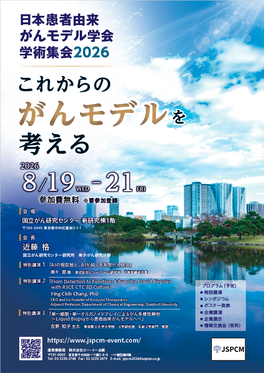
A2サイズ ポスター


A4サイズ チラシ
Sponsors